Vet Tools

Everything your exotic vet needs —
already organized before you walk in.

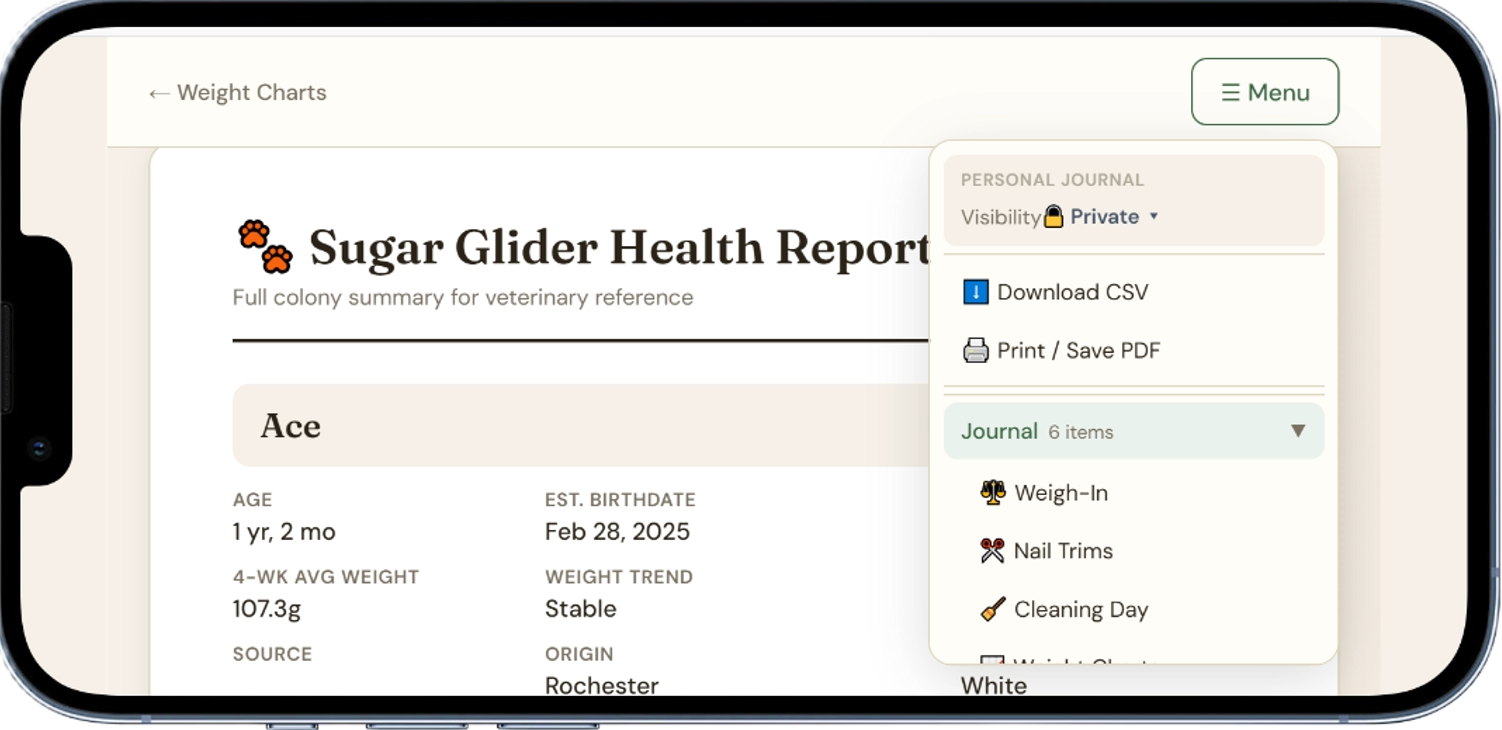
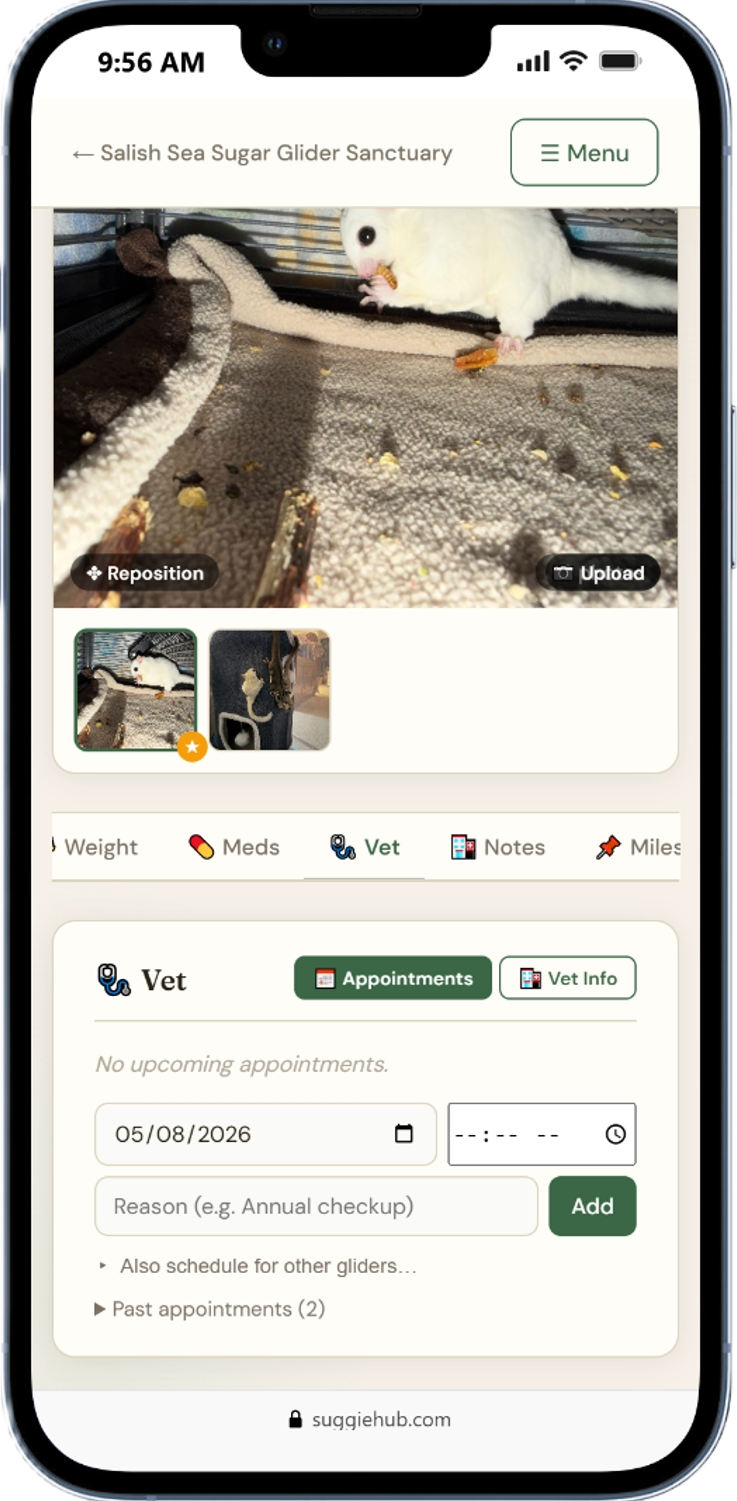
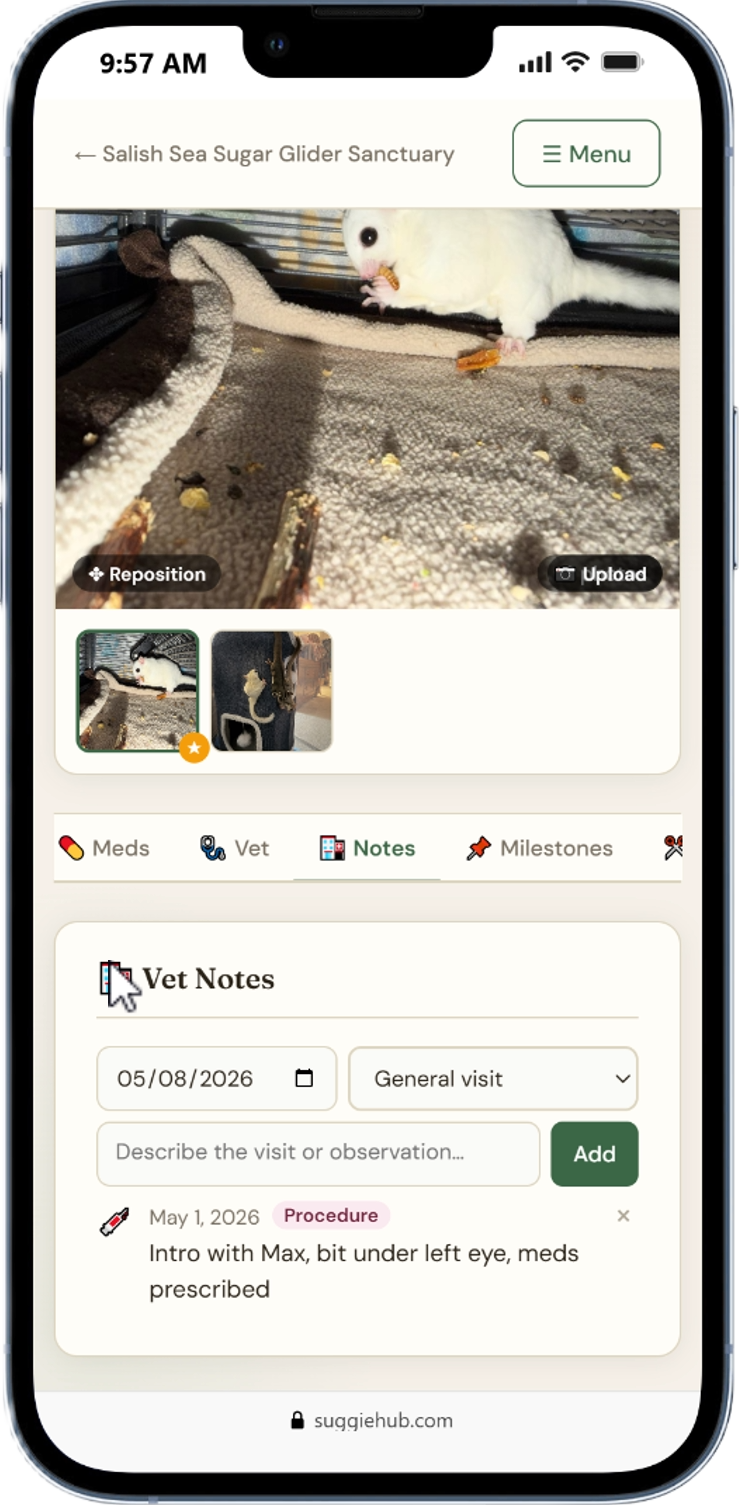
Schedule vet appointments per glider or for a whole cage at once. Log visit notes by type. Then export a complete Sugar Glider Health Report — weight trend, medications, full visit history — ready to hand to your vet or send to a rescue coordinator.

Sugar glider vet appointment scheduling interface showing upcoming visits Vet notes log showing visit notes organized by type and date Sugar glider health report export ready to share with exotic vet
Start tracking vet visits free

Why exotic vet care for sugar gliders is different

Not every vet sees sugar gliders. Finding one who does — who understands their anatomy, their unique stress responses, and the conditions they're prone to — takes real effort. When you find a good exotic vet, that relationship is worth protecting. And one of the best things you can bring to that relationship is excellent records.

Exotic vets who see sugar gliders regularly will tell you that the most useful thing an owner can do before a visit is write down what changed and when. Not "she's been off lately" — but "her weight dropped 5 grams over 18 days, she started refusing her protein portion on the 12th, and she had two soft stool observations this week." That kind of specificity narrows the differential diagnosis immediately and gets your glider the right answer faster.

SuggieHub's vet tools make that level of documentation effortless. Every visit, every note, every appointment is logged and timestamped. The health report export compiles it all into a single document your vet can scan in seconds — or that you can email to a specialist before a referral visit.

Three note types — because not every visit is the same

Vet visit notes aren't one-size-fits-all. SuggieHub lets you log notes in three categories so your visit history stays organized and easy to search:

📋 General

Routine check-ins, wellness visits, weight checks at the clinic, and anything that doesn't fit neatly into a procedure or observation. The default type for most visits.

🔬 Procedure

Dental work, neuter, pouch cleaning, wound treatment, blood draw, or any hands-on intervention. Keeping procedures separate makes your history easier to scan.

👁️ Observation

Things the vet noticed but didn't immediately treat — a developing cataract, early tartar, slight weight asymmetry between bonded pair. Worth logging and watching.

Full vet toolkit — scheduling to export

From the appointment to the health report, every step is covered.

📅

Per-glider appointment scheduling

Schedule upcoming vet appointments for any individual glider with date, time, and notes. Upcoming visits appear in the glider's profile.

🏠

Bulk cage appointment logging

Schedule or log a vet visit for every glider in a cage with one action — ideal for annual wellness rounds and new intake exams at rescues.

📝

General visit notes

Log routine visit notes with date, vet name, and full content. Searchable and always attached to the glider's history.

🔬

Procedure notes

Log procedures separately — neuters, dental, wound care — so they stand out in the history when you need to find them quickly.

👁️

Observation notes

Track things to watch over time — early findings, behavioral changes noted by the vet, developing conditions not yet requiring treatment.

📄

Full health report export

Export a complete PDF-ready health report combining weight trend, medications, visit history, birthdate, and source — all in one document.

📈

Weight trend included in export

The weight chart — with rolling average and trend line — is embedded in the health report so your vet can see the full picture at a glance.

💊

Medication list in export

Active and recent medications, with dosage and course dates, are included in the health report so your vet knows exactly what the glider is on.

📚

Complete visit history

Every logged visit, in chronological order, with note type and full content — always accessible on the glider's profile and always included in the export.

🔗

Shareable with new vets

When you switch vets or get a referral, the health report travels with the glider. No need to reconstruct history from memory in a new exam room.

What's in the Sugar Glider Health Report export

  • Glider name, birthdate, and gender
  • Source and acquisition date
  • Current weight and weight trend chart
  • 4-week rolling average
  • Active medications and dosages
  • Medication course history
  • Full vet visit log (all note types)
  • Procedure history summary
  • Observation notes
  • Housing and cage assignment

Why complete records make your vet visits better

Exotic vets are often working with limited time and exotic animals whose owners have highly variable levels of documentation. When you walk in with a complete health report — printed or on your phone — you're communicating something important: you take this seriously, and you have the data to back it up. Vets notice. It changes the quality of the conversation you have in that exam room.

The history matters just as much as the current visit. If your glider was seen for a URI six months ago, your vet needs to know if this visit's symptoms are a recurrence or something new. If a procedure was done at another clinic, the new vet needs to know what was done and when. The health report ties all of that together — not because it's nice to have, but because gaps in history lead to gaps in care.

For rescues, the health report is also what travels with an adopted glider. When a glider leaves your rescue to go to their forever home, the adopter's new vet will start from zero unless you send records. A complete export from SuggieHub gives the new owner something real to hand their exotic vet on day one — intake exam notes, weight baseline, any medications or procedures during the rescue stay, behavioral observations. That continuity matters for the glider's care.
From appointment to health report

Schedule visits, log notes by type, and export everything into a single document your vet can actually use.

Vet appointment scheduling screen for sugar glider — showing upcoming visit Vet notes log showing visit notes by type — general, procedure, observation Sugar glider health report export preview showing weight chart, medications, and visit history

Questions about vet tools

How do I share my glider's health record with my vet?
There are two ways. First, you can export a PDF health report — for an individual glider or your entire colony — that includes the weight trend chart, medication history with dosage and course dates, and the full vet visit log organized by note type. Hand it over at the appointment or email it ahead of time. Second, you can set a glider's profile to public and share the direct URL with your vet. Only people you give the link to can access it — the profile won't appear in search results or be visible to anyone else.
Can I schedule future appointments?
Yes. The appointment scheduling tool lets you set a future date and add notes about what the visit is for — annual wellness, follow-up, dental check, or anything else. Upcoming appointments appear on the glider's profile so you can see them at a glance. You can also log past visits after the fact, so your history doesn't have gaps if you start using SuggieHub after the glider has already been seen.
What's the difference between note types?
General notes are for routine visits — wellness checks, weigh-ins at the clinic, anything that doesn't involve a procedure or a specific finding to watch. Procedure notes are for hands-on interventions — neutering, dental work, wound care, blood draws. Observation notes are for things the vet flagged but didn't treat immediately — early signs to monitor over time. Separating them makes the history much easier to scan when you need to find something specific.
Can I add notes from past visits?
Yes. When you log a vet note, you choose the date — it doesn't have to be today. You can backfill your entire visit history from paper records, a previous app, or memory. The history is organized chronologically regardless of when you entered it, so a note logged today for a visit six months ago will appear in the right place in the timeline.
Is this useful when switching vets?
It's one of the most useful things the vet tools do. When you switch exotic vets — whether you moved, your previous vet stopped seeing gliders, or you found someone better — you can export the full health report and hand it to the new vet at the first visit. They'll have weight history, medication records, and every visit note your previous vet saw. No reconstructing from memory. No gaps. The relationship with the new vet starts with complete information instead of starting from scratch.

Free for owners, rescues, and breeders.

No credit card. No app to download. Your exotic vet deserves complete records — and so does your glider. Start logging today.

Sign up free

Always free. No catch. No card.